
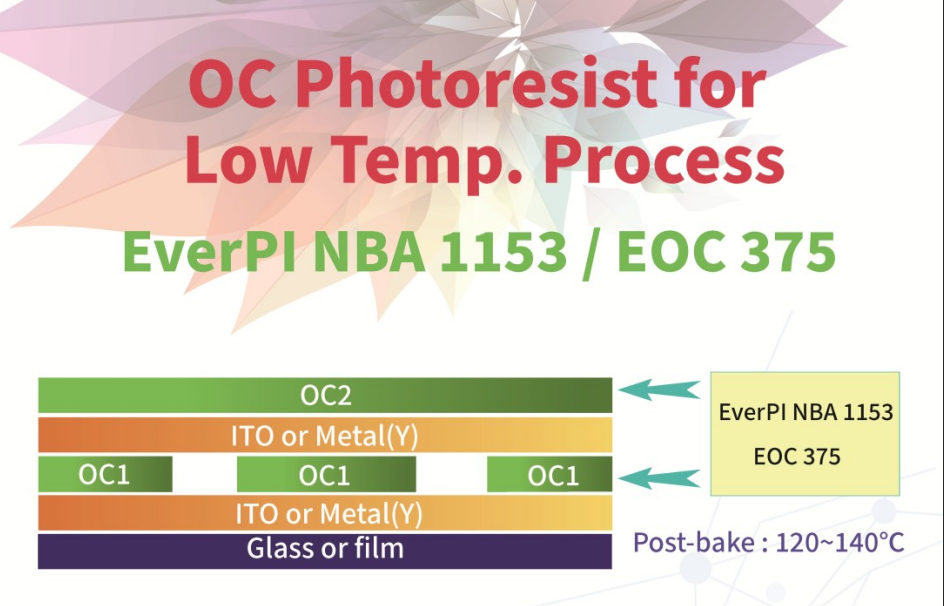
Ⅰ、EverPI NBA 1153/EOC 375
Property:
EverPI NBA 1153
1. Applied to rigid or flexible touch panel design.
2. Suitable for OC1 and OC2 Application.
3.For low temperature process.(120-140℃).
4.Surface hardness.(≥H@500g)
5.Excellent chemical resistance.
6.Excellent moisture resistance.
7.Suitable for KoH type developer.
EOC 375
1. Applied to rigid or flexible touch panel design.
2. Suitable for OC2 Application.
3. For low temperature process.(120-140℃).
4. High Surface hardness.(≥3H@500g)
5. Good chemical resistance.
6. Good moisture resistance.
7. Suitable for KoH type developer.
Ⅱ、Application Fields:
1. Touch Panels (Core Application):
As a key material for projected capacitive touch panels, low-temperature curable OC photoresist is compatible with On-Cell and In-Cell structural integration and is widely used in smartphones and tablet computers.
2. AMOLED Display Panels:
It serves as the insulating layer and pixel defining layer in AMOLED manufacturing processes. The low-temperature curing formulation perfectly adapts to flexible display requirements
Applied as a planarization layer for next-generation Micro LED technology, it stabilizes pixel electrical performance and delivers uniform and high-quality display results.
3. Micro LED Displays:
For next-generation Micro LED technology, EOC photoresist is utilized as a planarization layer to stabilize pixel electrical performance and ensure superior display quality.
4. Automotive Displays:
The material supports the manufacturing of large-size, high-resolution automotive display terminals, enabling high-transparency OC coating solutions and Micro LED head-up display (HUD) applications for vehicle scenarios.
5. Emerging Display and Sensing Devices:
It is used for planarization and surface protection of TFT (thin-film transistor) arrays. In LED sensor applications, it provides excellent optical transmittance, stable surface resistance, and robust adhesion to silicon wafers.
