
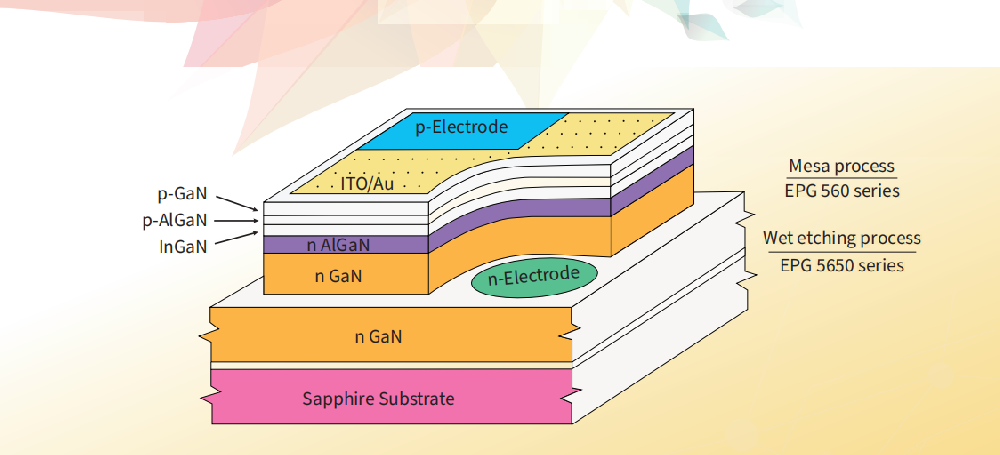
Ⅰ、EPG 562 series
EPG 567 series
EPG 5650 series
Resist Film Thickness:7~20um
Property:
1. Excellent ability to resist dry etching;
2. Different viscosity and profile shape series to meet a variety of customer needs.
Ⅱ、Application Fields:
1. Discrete Semiconductors and Power Chips:
Widely adopted in the fabrication of components such as diodes and transistors.
2. Micro-Electro-Mechanical Systems (MEMS):
G-line lithography serves as a mainstream and reliable solution for the processing of micron-scale structures including MEMS sensors and microfluidic devices.
3. Analog and Mixed-Signal ICs:
Deployed in the production of analog and radio frequency (RF) circuits that do not demand ultra-fine linewidths yet prioritize device matching and process stability.
4. Advanced Packaging:
A key candidate material for lithography processes in advanced technologies such as Wafer Level Packaging (WLP), Fan-out Packaging and Through-Silicon Via (TSV).
5. Front-End IC Manufacturing:
G-line photoresists retain limited applications in certain conventional CMOS processes, including the production of power management ICs and display driver ICs.
